Though I do not remember in which war the following occurrence took place, the story is often told of the two opposing armies dug into trenches at opposite sides of a great field of battle anticipating the next day's struggle. It was Christmas Eve. Suddenly a lone voice from one of the sides softly sang "Silent Night." Before long, both sides joined together in the hymn. Though the languages were different, the sentiment was the same and both sides were united in recounting through song the story of the birth of the Savior who came to earth that humanity might be united and that there would be peace. Sadly, the battle came and those men who had joined voices proceeded to kill one another. It is perhaps the most tragically ironic story I have ever heard.
As the angels announced to the shepherds in the Gospel of Luke, Christ the savior was born to bring peace on earth and goodwill to humanity. Our salvation is not simply that Christ comes into our hearts and saves us from our sins. Integral to the salvation that Christ wrought is the coming together of humankind. And the fruit of that unity is peace. As we celebrate this Christmas may we remember that peace has not yet been realized. May we realize that we each have a part to play in its coming. And may our solemn prayer be that the Prince of Peace would yet bring peace.
"Silent night, Holy night.
All is calm, all is bright.
'Round yon Virgin Mother and Child.
Holy Infant so tender and mild.
Sleep in Heavenly peace,
Sleep in Heavenly peace.
"Silent night, Holy night.
Shepherds quake at the sight.
Glories stream from Heaven afar.
Heavenly hosts sing Hallelujah.
Christ, the Savior is born,
Christ, the Savior is born.
"Silent night, Holy night.
Son of God, love’s pure light.
Radiant beams from thy Holy face
With the dawn of redeeming grace
Jesus, Lord, at thy birth,
Jesus, Lord, at thy birth."
-Joseph Mohr
Monday, December 24, 2007

Friday, December 21, 2007
Isaiah 40 and a Message of Hope
This Advent hymn was written in Johann G. Olearius in 1671 and translated into English by Catherine Winkworth in 1863. The words are based on Isaiah 40, which is the classic chapter of expectant waiting in the prophet and in the entire Old Testament. These opening verses of Isaiah were picked up by three of the four Gospel writers as the opening to their Gospels. It speaks of a people longing for salvation and peace. It speaks of a people longing for comfort. The Gospel writers appropriated the verses because they knew that the peace had come in Christ.
"Comfort, comfort ye my people,
speak ye peace, thus saith our God;
comfort those who sit in darkness,
mourning 'neath their sorrow's load;
speak ye to Jerusalem
of the peace that waits for them;
tell her that her sins I cover,
and her warfare now is over.
"For the herald's voice is crying
in the desert far and near,
bidding all men to repentance,
since the kingdom now is here.
O that warning cry obey!
Now prepare for God a way!
Let the valleys rise to meet him,
and the hills bow down to greet him.
"Make ye straight what long was crooked,
make the rougher places plain:
let your hearts be true and humble,
as befits his holy reign,
For the glory of the Lord
now o'er the earth is shed abroad,
and all flesh shall see the token
that his word is never broken."
Monday, December 17, 2007
Advent's Deep Meaning
The hymn "Lo, He comes with clouds descending", though originally written by John Cenick in 1752, was appropriated and altered by Charles Wesley in 1758 for the Methodists as an Advent hymn. Over the years, it became an Advent standard, not just of the Methodists, but of many other Protestant traditions as well. This hymn is regularly sung, in many churches, on the first Sunday of Advent. Reading the words, however, one might wonder what it has to do with Advent. After all, there is not much here about Bethlehem or babies in mangers and the like. Rather, it focuses more on the second coming of Christ.
As it so often does, then, the liturgy reminds the Church of a truth oft forgotten today. Advent was not established by the Church as merely a time to look back on the incarnation. Rather, in preparing our hearts to celebrate Christmas and the coming of the Christ child, the season of Advent reminds us that we are once again waiting expectantly for our Lord. Jesus has promised us that He will come back and the work that He started on earth so many years ago will be brought to fruition in the complete realization of His Kingdom, of which the Church is a foretaste. We again await our coming King, and no season reminds us of this truth better than Advent. For we, like our Fathers of Israel so long ago, long for our Messiah. The only difference is that we know His name and we know that He has already conquered death.
"Lo! He comes with clouds descending,
Once for favored sinners slain;
Thousand thousand saints attending,
Swell the triumph of His train:
Hallelujah! Hallelujah! Hallelujah!
God appears on earth to reign.
"Every eye shall now behold Him
Robed in dreadful majesty;
Those who set at naught and sold Him,
Pierced and nailed Him to the tree,
Deeply wailing, deeply wailing, deeply wailing,
Shall the true Messiah see.
"Every island, sea, and mountain,
Heav’n and earth, shall flee away;
All who hate Him must, confounded,
Hear the trump proclaim the day:
Come to judgment! Come to judgment! Come to judgment!
Come to judgment! Come away!
"Now redemption, long expected,
See in solemn pomp appear;
All His saints, by man rejected,
Now shall meet Him in the air:
Hallelujah! Hallelujah! Hallelujah!
See the day of God appear!
Answer Thine own bride and Spirit,
Hasten, Lord, the general doom!
The new Heav’n and earth t’inherit,
Take Thy pining exiles home:
All creation, all creation, all creation,
Travails! groans! and bids Thee come!
The dear tokens of His passion
Still His dazzling body bears;
Cause of endless exultation
To His ransomed worshippers;
With what rapture, with what rapture, with what rapture
Gaze we on those glorious scars!
Yea, Amen! let all adore Thee,
High on Thine eternal throne;
Savior, take the power and glory,
Claim the kingdom for Thine own;
O come quickly! O come quickly! O come quickly!
Everlasting God, come down!"
Thursday, December 13, 2007
Come Thou Long Expected Jesus
Here is another classic Advent hymn from the pen of Charles Wesley. Written in 1745, this hymn highlights what is often lost these days, that Jesus was the fulfillment first of Israel's hopes for a redeemer. And as the hope of Israel, Jesus was truly the hope of the world.
"Come, thou long expected Jesus,
born to set thy people free;
from our fears and sins release us,
let us find our rest in thee.
Israel's strength and consolation,
hope of all the earth thou art;
dear desire of every nation,
joy of every longing heart.
"Born thy people to deliver,
born a child and yet a King,
born to reign in us forever,
now thy gracious kingdom bring.
By thine own eternal spirit
rule in all our hearts alone;
by thine all sufficient merit,
raise us to thy glorious throne."
Monday, December 10, 2007
Veni, Veni Emmanuel
This great Advent hymn comes from the translating talents of John Mason Neale, based on the text of the O Antiphons of the Catholic Breviary for the week preceding Christmas. The phrase "Veni, veni Emmanuel" could be as old as the twelfth century. The name comes from Isaiah's prophecy. As the prophet records, it means "God with us!"
"Oh come, oh come, Emmanuel.
And ransom captive Israel.
That mourns in lowly exile here,
Until the Son of God appears.
Rejoice! Rejoice! Emmanuel
Shall come to thee o Israel.
"Oh, come, our Wisdom from on high,
Who ordered all things mightily;
To us the path of knowledge show,
and teach us in her ways to go.
Rejoice! Rejoice! Emmanuel
Shall come to you, O Israel!
"Oh, come, oh, come, our Lord of might,
Who to your tribes on Sinai's height
In ancient times gave holy law,
In cloud and majesty and awe.
Rejoice! Rejoice! Emmanuel
Shall come to you, O Israel!
"Oh, come O Rod of Jesse's stem,
From ev'ry foe deliver them
That trust your mighty pow'r to save;
Bring them in vict'ry through the grave.
Rejoice! Rejoice! Emmanuel
Shall come to you, O Israel!
"Oh, come, O Key of David, come,
And open wide our heav'nly home;
Make safe the way that leads on high,
And close the path to misery.
Rejoice! Rejoice! Emmanuel
Shall come to you, O Israel!
"Oh, come, our Dayspring from on high,
And cheer us by your drawing nigh,
Disperse the gloomy clouds of night,
And death's dark shadows put to flight.
Rejoice! Rejoice! Emmanuel
Shall come to you, O Israel!
"Oh, come, Desire of nations, bind
In one the hearts of all mankind;
Oh, bid our sad divisions cease,
And be yourself our King of Peace.
Rejoice! Rejoice! Emmanuel
Shall come to you, O Israel!
Thursday, December 06, 2007
A Wesleyan Take on Advent
I am a Wesleyan, and one of the things that I love most about my tradition is the importance that we have always placed on hymnody. John Wesley never wrote a systematic theology, as many of the other great Protestant leaders (Luther, Calvin) did. But he and his brother Charles wrote a number of hymns for the people called Methodists to use in worship. Wesleyan theology comes through beautifully in the words of those magnificent hymns:
"And can it be that I should gain, an interest in the Savior's blood. Died he for me who caused his pain, for me? who him to death pursued?"
"Made like him, like him we rise. Ours the cross, the grave, the skies."
To express one's theology in hymns, as the Wesleys did, symbolically expresses the truth that all true theology is never divorced from worship. And that the church is the context for theology.
With this in mind, I have decided, as part of the preparation of my own heart to "prepare him room" for the coming of the Savior this Advent, to reflect anew on the wonderful words of the beautiful, but now oft forgotten, Christmas carols. I would like to share them with my readers. So as you check in here throughout these next few weeks, do not just read the words and move on. Use these wonderful words as a means of preparing your own hearts.
Because this is a Wesleyan take on Advent, I thought it would be appropriate to start with one of Wesley's best:
Hark! The Herald Angels Sing
"Hark! The herald angels sing
'Glory to the newborn king!'
Peace on earth and mercy mild.
God and sinners reconciled.
"Joyful all ye nations rise.
Join the triumph of the skies.
With angelic host proclaim:
'Christ is born in Bethlehem!'
"Christ by highest heaven adored.
Christ the everlasting Lord.
Late in time behold him come,
Offspring of the virgin's womb.
"Veiled in flesh the Godhead see
Hail the incarnate deity.
Pleased as man with men to dwell.
Jesus our Immanuel.
"Hail the heaven-born Prince of Peace.
Hail the Son of Righteousness!
Light and life to all He brings
Risen with healings in His wings.
"Mild He lays His glory by,
Born that man no more may die.
Born to raise the sons of earth.
Born to give them second birth.
"Hark! The herald angels sing.
'Glory to the newborn king!'"
Monday, December 03, 2007
ADVENTUS
"Tears are falling, hearts are breaking.
How we need to hear from God.
You've been promised, we've been waiting.
Welcome Holy Child.
"Hope that you don't mind our manger.
How I wish we would have known.
But long awaited Holy Stranger,
Make yourself at home.
Bring your peace into our violence.
Bid our hungry souls be filled.
Word now breaking heaven's silence.
Welcome to our world.
"Fragile fingers sent to heal us.
Tender brow prepared for thorn.
Tiny heart, whose blood will save us
unto us is born.
"So wrap our injured flesh around you.
Breath our air and walk our sod.
Rob our sin and make us holy.
Perfect son of God.
Welcome to our world."
-Chris Rice
Saturday, November 17, 2007
Theological Poetry
"God gives all He has to give -
His son to speak that one word, Live."
-Joseph Bottom
His son to speak that one word, Live."
-Joseph Bottom
Thursday, November 15, 2007
The Rich Symbolism of Baptism
One of the most contentious issues in the church today is baptism. "Should we sprinkle?" "Should we immerse?" "Do you have to be baptized to be saved?" "Should we baptize infants?" "Should we re-baptize?" And around and around we go. Unfortunately, our hangups on these issues cause us to miss the deep theological beauty that is signified in baptism.
In three Gospels (Matthew, Mark, and Luke) we have the account of Jesus submitting to the baptism by John. This is strong evidence that one of the earliest memories of Christ was his being baptized. Perhaps it was the first public act that anyone witnessed Jesus do. Baptism in Judaism was the way that Gentile converts (Godfearers) could enter the fold of Judaism. It symbolized a passing through water, much like the Hebrew slaves passed through the Red Sea in their Exodus from Egypt and passed through the Jordan in their march into the Promised Land. Significantly, Jesus is baptized in the Jordan, thus sanctifying the act as a Christian sacrament. Matthew records that Jesus' last command to his disciples was: "Go therefore and make disciples of all nations, baptizing them in the name of the Father and of the Son and of the Holy Spirit" (Mt 28:19). So, then, one of our earliest liturgical, Trinitarian creeds, comes in the context of baptism.
The early Christians developed the theology around this earliest of Christian rites. The writer of 1 Peter, for example, sees in baptism an antitype of the Ark: ". . . God's patience waited in the days of Noah, during the building of the ark, in which a few, that is, eight persons, were saved through water. Baptism, which corresponds to this, now saves you, not as a removal of dirt from the body but as an appeal to God for a clear conscience, through the resurrection of Jesus Christ" (1 Pt 3:20-21).
Paul, though capable of the Jewish connection of baptism to the crossing of the Red Sea (1 Cor 10:1-2), he rather prefers baptism as the symbol of our dying with Christ and so rising with him in new life: "Do you not know that all of us who have been baptized into Christ Jesus were baptized into his death? We were buried therefore with him by baptism into death, so that as Christ was raised from the dead by the glory of the Father, we too might walk in newness of life. For if we have been united with him in a death like his, we shall certainly be united with him in a resurrection like his" (Rom 6:3-5). Such imagery does likely not originate with Paul, but is taken from the rite of baptism itself that developed early in the history of the church: on Easter Sunday, all of the catechumens were taken to a river, stripped naked, and descended into the water (symbolizing death). When they came out of the water, they were given white robes (symbolizing new life). As Paul says later in the same letter: "But put on the Lord Jesus Christ . . ." (Rom 13:14).
As theology and Christian thought developed, the dominate connection to baptism became circumcision. That is the mark that God commanded Abraham and all male Jews after him to receive as a sign that they were in the covenant and, thus, a sign of their salvation. Corresponding to this, baptism became the mark that one was in the new covenantal people of God, the Church, and, thus, was also a sign of their salvation.
I think that there is truth in all of these metaphors, each displaying a different facet of the wonderful sacrament that has been given the Church in baptism. What I think interesting about the circumcision comparison, and I will conclude with this, is that Christians, as they always did and do, appropriated the metaphor through the lens of Christ. In other words, circumcision, as is obvious, only involved the male. Therefore, a female's part in the covenant came through her participation in the lineage as a mother or daughter. (Incidentally, this is why widows and orphans are such a problem in the Old Covenant.) Yet, as strong as the correlation between baptism and circumcision became in the Church, this distinction of sexes (to the detriment of women) was never held. Baptism, as such, is the same rite for both men and women. Both descend into the water, and so die, and both ascend out of the water into newness of life with Jesus Christ.
Monday, November 12, 2007
Responsa quaestiones
This past summer, much was made of Pope Benedict XVI's supposedly derogatory statements regarding Protestant churches, namely that they are not properly to be called "the Church," but rather "ecclesial communities." This upset a lot of Protestants, and subsequently caused a general lament for the current leadership of the pontificate. Pope Benedict became the subject of much derision, and I heard it claimed that he is "rolling back all of the positive progress made by Vatican II and John Paul II." Of course I, curiously, never was able to find the actual document where these comments were made. I must admit that I was suspicious of the whole affair because, first, I tend to give Roman Catholicism the benefit of the doubt in many areas where most of my Protestant brethren are ready to throw it to the lions; and, second, because I know Pope Benedict XVI to have been one of the leading theologians at Vatican II. It simply did not make sense to me that he would now "roll back" any progress.
Recently, I finally located the comments. It turns out that they were not made at random by the Pope to stir up divisions or to change the teaching of Vatican II. Rather, they came in the form of a document, Responsa quaestiones, written by the Congregation for the Doctrine of Faith (CDF) and endorsed by the Pope. You can read it here. This document was written as an official response to the lingering questions by the Catholic faithful resulting from Vatican II's teaching on the nature of the Church. As such, it did not change the teaching of Vatican II, but merely clarified it.
The teaching of Vatican II is as follows:
1. The Church is the visible communion of the people of God, signified in the Holy Eucharust, who are called by the Father and redeemed by the Son, who are pilgrims on this earth, having a foretaste of the kingdom of Heaven in the presence of the Spirit yet moving toward the full realization of the kingdom in eternity.
2. The Church subsists in the Catholic Church.
The second statement is where most perceive a change in Catholic teaching. Namely, Vatican II no longer equated the Church with the Roman Catholic Church, an equation that was being made as late as the middle of the twentieth century. It did not equate the two because it recognized, what it called "ecclesial elements" outside of the Catholic Church. Ecclesial elements are those things such as the Scriptures, the sacraments, etc. Therefore, though the fullness of the ecclesial elements exists only in the Catholic Church, they do not deny the presence of some or many of them elsewhere, and consequently, though these latter communities are not in full communion with the Catholic Church, they are not denied communion with God or salvation.
The recent document in question did not change any of this progress. Rather, it affirmed that, in the belief of the Catholic Church, Protestant churches are not called the Church, because they lack apostolic succession (our ministers do not go back to the apostles through the sacrament of ordination) and the teaching of the real presence in the Eucharist, a dogma held firm through history. As such, we have imperfect communion with the Catholic Church.
Yet, as Protestants, we must not see this as a slap in the face; rather, it is the Catholic Church faithfully professing what it believes. We are not denied salvation, we just do not have the fullness on earth - as such, we are wounded. "But even in spite of (these doctrinal differences) it remains true that all who have been justified by faith in baptism are incorporated into Christ; (separated brethren) therefore have a right to be called Christians, and with good reason are accepted as sisters and brothers in the Lord by the children of the Catholic Church" (Unitatis Redintegratio 3).
But the Catholic Church also teaches that she herself is wounded because the full visible communion of God's people is not yet realized. Thus, our mission to the world is jeopardized. This belief is one of the reasons why the Catholics, since Vatican II, have been the most diligent workers in the ecumenical movement, that is the movement toward greater unity of all Christian denominations. This was "one of the principle concerns of the Second Vatican Council" (Unitatis Redintegratio 1).
Before we Protestants point out the speck in the eye of the Catholic Church, we would do well to pull the plank out of our own eye. I have heard much worse said about Catholics in Protestant and evangelical circles. Its time we put these petty characterizations aside and work for the greater unity of all of our denominations. For we all believe in the same Triune God, we all believe that God has revealed himself foremost in His Scriptures, and we all believe that apart from Christ, there is no life.
"I do not ask on behalf of these alone, but for those also who believe in Me through their word; that they may all be one; even as you, Father, are in Me and I in You, that they may also be in Us, so that the world may believe that You sent Me." -Jesus
Sunday, November 04, 2007
For All the Saints
Today is All Saints Sunday, an important day in the Christian calendar that, unfortunately, often goes unnoticed. It is the day that we celebrate the lives of all the saints who have passed on from this life and have joined the Church triumphant. No more are these saints fighting the fight on earth; rather, they have joined that great cloud of witnesses where they participate in the true worship of our heavenly Father of which our worship here is only a shadow. In many churches, candles are lit and the names are solemnly read aloud of all those who have died in the past year. I was able to call out the name 'John Barber,' my grandfather who passed away in late September.
I suspect that the reason that this day is not so much celebrated in our culture is because death is not a regular thing in our churches. Sure we experience it when our older members pass on, and that is certainly sad. But death is not shocking to us. It is a normal occurrence in our lives. It was not so in the early church. In those first few centuries, a person could be tried and put to death simply for having the name Christian. All someone needed to do was accuse a person as a Christian, and his or her death ticket was all but signed. In that situation, death was a regular occurrence. One can imagine regular reports of members of local churches being read in those early church services. One can imagine the shock that would have rung out in the congregation. When those early communities celebrated the names and lives of those who had passed in the last year, they were not just celebrating the grandmothers and grandfathers, they were celebrating the husbands and the wives and the children.
But today is not a sad day, it is a triumphant day. As we read off the names of the saints who have passed on, we are reminded that death is no longer the final act of a person's life. It is merely a comma. Because Christ rose, these saints too will rise, and one day soon, the Church will all together again in the heavenly worship of our Triune God.
"For all the saints, who from their labors rest,
who thee by faith before the world confessed,
thy name, O Jesus, be forever blest.
"O blest communion, fellowship divine!
We feebly struggle, they in glory shine;
Yet all are one in thee, for all are thine."
-William W. How
Thursday, November 01, 2007
And So This Is Mixmas
So I turn on the radio this morning and I am informed by local radio station 99.1 'The Mix' that the Christmas season is upon us. Or to be more correct, the 'Mixmas' season: all Christmas music, all the time. So for the next two months, I can be guaranteed a steady stream of Brenda Lee's 'Rockin' Around the Christmas Tree', Lennon's 'So This is Christmas', a various assortment of Neil Diamond Santa tunes, and the ubiquitous 'Same Old Lang Syne' by Dan Fogelberg. I'd like to drink a toast to his innocence. Two things bug me about this.
First of all, these radio stations have, for the most part, removed all Christmas songs having anything to do with Christ. Therefore, we are forced to here the same songs over and over again by different artists, and they are all about Frosty or Santa or snow. The profound irony here is that, if this is what Christmas has been reduced to, then what are we celebrating for two long months? How many different versions of 'Santa Claus is Coming to Town' one generation can produce? Or how many pitches Bruce Springsteen actually falls short in trying to reach the high notes in his embarrassingly awful version of the same?
Second, and even more concerning to me, is the redefining of the Christmas season itself. In capitalist America, where the veil of Christmas is still encouraged for the sheer revenue that it generates, the celebration begins immediately after Halloween. Stores are turned from orange and black to red and green. Pumpkins are replaced with holly. Candy corn is replaced with candy canes. And scary stuffed men are replaced with Santa Clauses. The pumpkin patches in the middle of malls are replaced by Santa's Workshop. And of course, Christmas music is everywhere. This continues through December 25th, when all of the buying is occurring, but then magically on the 26th it is all gone. The Santas removed, the colors changed, and the Christmas music gone. As American Christians, this seems quite normal and many of us capitulate, removing our lights and trees by New Years Eve. We eliminate all traces of the celebration from our houses almost as quickly as the stores. What we don't realize, however, is that the Christmas season has been redefined for us by the retailers.
According to the Christian calendar, the season begins with the Feast of Advent, the first Sunday of which is the first Sunday of December. What follows is several weeks where we prepare our hearts through meditation on the incarnation, acts of mercy, and fasts to receive our coming king Immanuel. The Feast of the Nativity, or Christ Mass, begins on December 25 and continues until January 6. We are meant to revel in the reality that our savior has come to earth and has been born. We are meant to celebrate and feast this reality for two weeks. But we don't. Instead we tear it all down as soon as it has begun, giving ourselves hardly any time to appreciate the wonder. And we go back to our daily lives, not realizing that the world has changed - God has entered it.
I do not blame the retailers or even the radio stations - they do not know any better. But we as Christians should. We should reclaim the significance of our feast. And we should start by celebrating it according to the time of holy tradition, not according to the time of 'Mixmas.'
Wednesday, October 24, 2007
Methodists Beware!
"There is nothing more grotesque than to think of a Christ who would want to establish committees."
-Hans Urs von Balthasar
Amen and Amen!
-Hans Urs von Balthasar
Amen and Amen!
Thursday, October 18, 2007
Inspiration (2)
"In matters of faith, no [one], not even the Pope or the bishops, possesses the truth . . . This divine truth possesses us . . . Truth takes possession of us. But we must go a step further. It does not take possession of us individually, for this truth is entrusted before all to the Church. Similarly, at the level of the Church as a whole, we cannot strictly say: 'The Church is in possession of the truth, of the true faith.' Yet the true faith is unfailingly entrusted to the Church, the Body of Christ and the Bride of the Lord. It is entrusted to her as a sacred heritage which never becomes her own property. In other words, the sum total of her teaching will never exhaust all its wealth." -Piet Fransen
Agree or disagree? And with what specifically?
Agree or disagree? And with what specifically?
Sunday, October 14, 2007
A Chastened Critique of Joel Osteen
This evening, megachurch pastor and best selling author Joel Osteen was interviewed on 60 Minutes. I have elsewhere been rather critical of Osteen, in matters relating to both his theology and his motives. But after seeing his interview tonight, I feel that I am developing more of, what one might call, a chastened critique. Where before I questioned his motives, after seeing his interview this evening, I am convinced that he is quite sincere. He feels that he has a calling from God to give people hope, and judging from the personal testimonies of many, it seems that he is doing this. Moreover, I respect his decision to not ask for money on his television broadcasts and agree with him that such requests would likely hinder the message he is trying to send. And where before I might have questioned whether he was even a Christian, after seeing his interview this evening, I am convinced that he is, at least in what seems to be his narrow understanding of one. At one point, he was moved to tears at the prospect of God using him in such powerful ways. He also handled serious critiques with grace, which I think are marks of a Christian.
But while it is chastened, there still remains in my assessment of him a rather strong critique, and that is this: It seems to me that Osteen is profoundly confused on a number of issues pertinent to both the Christian life and to his position as the pastor of a church.
First, his understanding of the Gospel seems extremely shallow. As far as I can tell, he preaches a message that God wants to give you the best life possible on this earth, all you have to do is think positively, be faithful and he will bless you. This is simply not the Gospel in any sense of the word. The Gospel is a message of hope of deliverance of sin and communion with God. It speaks nothing of wealth in this life. In fact, its primary model of a faithful life is a homeless man whose life was violently cut short at 30 years of age. Neither is this the Gospel as experienced by a majority of Christians through history. The early martyrs knew nothing of Osteen's gospel, yet we believe that they are among the ones who most clearly understood Christ's project and
the only ones to live it out completely.
Second, Osteen is confused as to what his calling is. Is he a pastor? Is he a motivational speaker? Is he a writer of self help books? I would imagine that Osteen would say he is all of these things. But I think that the definition of a pastor is somewhat incongruent with the other two. For a pastor is not a motivational speaker. Motivational speakers are all about making people feel good. Pastors are called to preach the Gospel whether that brings hope or conviction. Sometimes people don't need to feel good. They need to feel bad so that they might be driven to God. And a pastor is not a self help author. For a self help author believes that a person only needs to implement a few reasonable habits or principles into their life and they can have the life they want. A pastor knows that there is no formula to this Christian life. Sometimes you can be praying consistently and have all the faith in the world, and your loved one still dies of cancer. A pastor knows that living the Gospel is not about implementing principles. It is rather about communion with the living God.
Therefore, it seems to me that Osteen is much more of a motivational speaker and self help author then he is a pastor. His new book has seven principles for "Becoming a better you" yet none of them mention God or Christ. How can a Christian pastor speak about personal development apart from Christ? Also, Osteen told the 60 Minutes interviewer that (paraphrase) "there are others much more qualified to understand and expound Scripture. I don't feel that's what I'm called to do." He was making the point that he wants to keep the message simple. But this is where he is wrong. It is precisely the job of a pastor to expound the Scripture. And the fact is that Scripture is hard in many places and it is the pastor's job to make that understandable, not just to keep it simple. If this is not what Osteen is called to do, then he is not a pastor. And given his understanding of the Gospel, I question whether the hope he is giving is the Christian hope in any meaningful sense of the word.
Saturday, October 13, 2007
An Open and Likely Unwanted Letter
To my dear and faithful readers (if there are any of you left):
My sincerest apologies for my absence of late from these pages. Much has been happening (or "has gone down" as the kids are now saying) these past few weeks and I am only now beginning to feel as if I'm getting my feet back under me. Of course, that will only last for a few days and then the flood will take them away from me once again, and I'll be left to wonder where the heck my Arky Arky is. In times like these, it is unfortunate but true that blogging is one of the first things in my life to go, second only to personal hygiene. But as this push is nearing its end, I anticipate to return to these pages shortly.
In all sincerity,
J. Lashier (long "a" soft "s")
Friday, September 28, 2007
We are One Another
An appropriate quote, I think, for this blog:
"I bear in my life of faith today the drama of Israel, the fruit of the costly discussions of Nicaea and Chalcedon, what Francis of Assisi mined in the mysteries of evangelical poverty, what thousands of obscure believers have affirmed of the power of hope in their responses to persecutors. And our successors will, in their time, be enriched by what African and Latin American Christianities in their contexts are working out before our eyes. The communion of saints is not relegated to the register of merits or of prayer. It already involves the fundamental plan of faith."
-Jean-Marie Roger Tillard
Thursday, September 20, 2007
Inspiration (1)
It seems to me that the church and her theologians spend an inordinate amount of time these days on the doctrine of inspiration. The idea that Scripture is inspired has, in fact, taken first place in the confessional statements of many churches (and seminaries for that matter), particularly those churches of the non-denominational/evangelical/megachurch variety. I find this odd, given that a doctrine of inspiration is not even present in the historic creeds; they, rather, all address the nature of the God who was revealed in Christ. To be sure, the Fathers believed that the Scriptures were inspired, they just did not feel the need to logically define how that mysterious process took place. In general, pre-moderns are much more comfortable with mystery than moderns are.
I suspect that the doctrine of inspiration has been so elevated in recent times because it has come under so much fire from more liberal (in the original sense of the word) sects of the church and those outside the church who hold a priori (or without even arguing for it) that such a doctrine is impossible. Thus, the great dividing line - what makes one a Christian or not - is shifted from what one believes in Christ (the historic definition) to what one believes about the inspiration of the Scriptures.
In one sense, this shift may be appropriate because unless one believes that the Scriptures indeed come from God, then one will not believe in the truth of the things which are said in them, and thus the entire faith crumbles. But in another sense, this shift is entirely inappropriate for it entails the addition of a creedal component that was not agreed upon by the Fathers when the church was still one entity; and, therefore, a creedal component which all parts of the church cannot agree upon. (Again, the church has always believed in the inspiration of her Scriptures, but not in the manner that it is defined by certain sects.) Moreover, this shift gives the disastrous impression of elevating belief in the inspiration of Scripture as the most important aspect of our faith.
Friends, this is simply not the case, and if this is how you have been taught, then you have been taught a faith that, at least in this respect, is in no way consistent with Christianity as passed on from the apostles. The truth is that the most important aspect of our faith, the aspect which Jesus came to earth to witness to is who God is. And all the creeds agree that God is Trinity - Father, Son, Holy Spirit - and, as such, a relational God who desires relation with his creation and will one day restore that creation to himself. All other creedal points - including the inspiration and authority of Scripture - flow out of this point. And as far as I know, you and I can agree on who God is without being completely in agreement on the nature of the word which tells us this. If the Fathers felt no need to define the great mystery of inspiration, I see no reason why we should.
Monday, September 17, 2007
The Communion of Saints - One Year Later
I am happy to announce to all of my readers that the Communion of Saints blogspot (hereafter CoS) has officially been in existence for a year today. I am carefully to add "blogspot" to the previous statement for I in no way want to imply that the Communion of Saints has been around for just a year. As I hope this blog has witnessed to, the Communion of Saints is a living communion that has existed since that original Pentecost nearly 2000 years ago. And according to Hebrews, our Fathers and Saints (that great cloud of witnesses) extends back into Israel's story, the communion of saints in potentia perhaps.
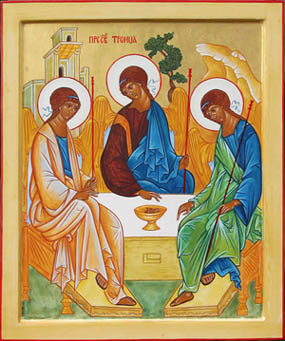
We have seen and, hopefully, experienced a bit of that communion here as I have tried to bring to the table pertinent topics for discussion and debate. I have also tried to represent significant voices from our past who we might not have been aware of, voices of the great Fathers like Irenaeus and Augustine. And we have heard from the living saints - you my readers, if there are any of you left. :) Of course, communion in cyber space is less than perfect for it is disembodied and the church, if anything is an embodied entity. Yet reading one another's thoughts and dialoging here can be a form of communion and can encourage us to seek out our local communities and foster embodied relationships there.
In honor of the passing of the year, I would like to offer you a few of my favorite posts from this past year. Enjoy! And as Babu Bhatt (of Seinfeld fame) said: "Tell your fliends!"
First Post: A Communion of Bloggers
Post which generated the most comments: Authentic Community
Most meaningless post: A Bit of Levity
Post with the biggest rant: Let's Leave THEM Behind
Thursday, September 13, 2007
Subscribe to:
Posts (Atom)


